
Bali sells a dream and a spreadsheet at the same time. This guide separates the two: what drives demand on the island, how a rental return is actually built once charges are paid, what tenure means for a foreign buyer, and how the four projects in our selection compare.
Why Bali, in plain numbers
Bali runs on tourism, and tourism came back hard. Developer documents circulating on the island quote 6.3 million foreign visitors in 2024, up around 19.5% on 2023, and occupancy above 90% year-round in the best-located villa clusters. Those figures come from the developers own decks, so treat them as a direction of travel rather than an audited baseline.
The supply side is the interesting part. Only a small share of the island is zoned for tourism and real estate, and the zoning is enforced: you cannot simply build a villa on rice-field land. That constraint is the single strongest argument for the south of the island, where the zoned pockets are already surrounded by five-star hotels.
Several large infrastructure projects are announced, from a second international airport in the north to a theme park and a cruise terminal. They are announcements. Do not price them into your own numbers until they are under construction.
How a rental return is really built
Take the model published by Almal for The One in Nusa Dua, which is unusually transparent. It starts from an average daily rate and an occupancy rate, then deducts, in order: booking and platform fees around 16% of gross income, utilities and community service charges around 4%, administration and personnel around 6%, marketing around 1.5%, then a management fee of 8% of the gross operating profit, and finally a 10% tax on withdrawal.
That chain matters more than the headline percentage. Gross income is not yield. On that model, roughly 60 to 70% of gross income survives to the owner before tax, and the developer arrives at 17% to 22% a year depending on the format. Those are the developer projections, not verified here, and no return is guaranteed.
When you compare two projects, compare the same line: net income after all charges, divided by the total you actually paid, options and fees included. Anything else is marketing.
What you actually own as a foreign buyer
Indonesia does not sell freehold to foreigners. In practice, purchases are structured as a leasehold right for a fixed term, a right-to-use title, or ownership through an Indonesian company. Each route has different consequences for resale, inheritance and tax.
The projects in our selection state their own terms: The One by Almal announces 25 years renewable for 15. Others publish their structure in the contract. Whatever the wording, the same rule applies: have the contract, the permits and the title reviewed by Indonesian legal counsel before you pay anything. This page is general information, not legal or tax advice.
Eight questions to ask before you reserve
- What exactly is included in the price: furniture, pool, landscaping, options.
- What the payment schedule is tied to: dates, or construction milestones.
- What the service charge covers, and who sets it after handover.
- Who manages the rental, at what fee, and whether you are free to change operator.
- What the tenure is, how it renews, and what happens at the end.
- What the real occupancy and average rate are in that specific micro-location, not the island average.
- What the exit looks like: who buys a unit like yours in five years, and at what price.
- Which permits are already issued, and which are still pending.
How the four projects compare
The four projects in our selection answer different strategies. A studio is a yield play: small ticket, frequent bookings, easier resale. A five-bedroom villa on the Bukit is an asset play: fewer bookings, higher nightly rates, more operational work. Prices are sent on request for each one, because availability and options move constantly, and because a headline figure tells you nothing about what is actually included.
| Project | Location | Formats |
|---|---|---|
| The One by Almal | Nusa Dua, Bali | Studio to 2-bedroom villa |
| EDEM II | Nusa Dua, Bali | Studio, 1 to 3-bedroom villas |
| The Eight Collective | Munggu / Seseh, Bali | 2-bedroom villa, pool and rooftop |
| Elements Villas | Dreamland, Uluwatu, Bali | 5-bedroom villa, 560 m² |
Prices are sent on request
One form, and you receive the current price list, the available units and the payment schedule.
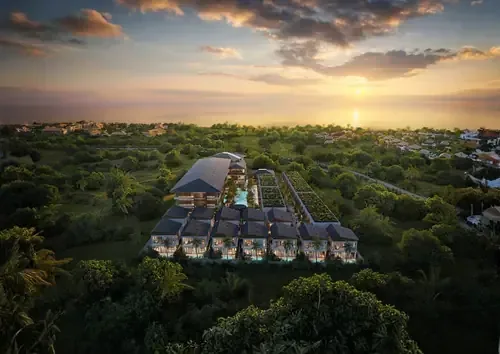

Architectural renderings from the developer brochure.
Frequently asked questions
What return can I expect on a Bali off-plan property?
No serious answer is a single number. Developer models for well-located Nusa Dua units point to 17% to 22% a year before tax in their own conservative scenario, but those are projections, not verified here, and no return is guaranteed. Your result depends on the nightly rate, occupancy, charges and who manages the property.
Can a foreigner own property in Bali?
Not as freehold. Foreign buyers usually hold a leasehold right for a fixed term, a right-to-use title, or ownership through an Indonesian company. The mechanism changes what you can resell, so it should be reviewed by Indonesian legal counsel.
Which area of Bali makes sense for a rental?
It depends on the audience you want. Nusa Dua draws resort and family travellers, the west coast around Munggu and Seseh draws the Canggu crowd, and the Bukit around Uluwatu draws surfers and high-end groups.
Is off-plan riskier than a finished villa?
It carries construction and delivery risk that a finished villa does not, in exchange for a lower entry price and a payment plan. The contract, the permits and the developer track record are what reduce that risk.
Figures quoted in this guide come from developer documents (brochures and return projections) collected in September 2026. They are reproduced as published, not verified by Off Plan Bali, and nothing here is investment, legal or tax advice.
Get the price list and the brochure
Tell us what you are looking for and we send the prices, the unit list and the payment plan privately.